Speed is one of the most practical numbers in everyday life — whether you’re figuring out how long a road trip will take, checking if your internet plan is actually delivering what you paid for, or working out how fast a cricket ball was bowled. This guide covers the core speed formula, how to use a speed distance time calculator, and how the same math applies across dozens of real-world situations: cars, trains, running, typing, internet speed, wind, sound, light, and more.
What Is Speed? The Basic Formula
Speed measures how much distance an object covers in a given amount of time. The formula for calculating speed is:
This is the foundation every speed calculator is built on, whether it’s estimating a car’s velocity or a download’s transfer rate. Rearranging this one formula gives you two more:
- Distance = Speed × Time (used when you know how fast something is moving and for how long)
- Time = Distance ÷ Speed (used when you know the distance and the speed, and need to find how long it takes)
These three versions of the same equation answer nearly every “how do I calculate speed, time, and distance” question people search for. A speed and distance calculator (or a full speed, distance, and time calculator) simply lets you plug in any two values and instantly solve for the third — no manual algebra required.
A Simple Worked Example
Say a car travels 150 km in 3 hours. Using the formula:
Now flip it: if you know the car travels at 50 km/h for 3 hours, distance = 50 × 3 = 150 km. And if you know it covered 150 km at 50 km/h, time = 150 ÷ 50 = 3 hours. This is exactly how a speed calculator online works — you enter any two known values, and it solves the third instantly.
Units Matter More Than the Math
The most common mistake in manual speed calculations isn’t the arithmetic — it’s mismatched units. If speed is in km/h but your time is in minutes, multiplying them directly gives a meaningless number. Always convert to matching units first:
- km/h → m/s: multiply by 0.278 (or divide by 3.6)
- m/s → km/h: multiply by 3.6
- mph → km/h: multiply by 1.609
A good speed calculator handles these conversions automatically, which is one of the biggest reasons people search for one instead of doing the math by hand.
How to Calculate Average Speed

Average speed is one of the most searched variations of this formula, and it’s different from instantaneous speed (your speed at one specific moment, like a car’s speedometer reading). Average speed looks at the whole trip:
How to Calculate Average Speed When Two Speeds Are Given
A common scenario: you travel part of a journey at one speed and the rest at another, and you want the overall average — not just a simple average of the two numbers. This is a frequent point of confusion, because the answer isn’t always (Speed1 + Speed2) ÷ 2.
If the distances are equal for each leg of the trip (say, you drive to a city at 60 km/h and back at 40 km/h over the same route), use the harmonic mean:
Using our example: (2 × 60 × 40) ÷ (60 + 40) = 4800 ÷ 100 = 48 km/h — not 50 km/h, which is what a simple average would incorrectly suggest.
If the times are equal instead (you drive for 1 hour at 60 km/h, then 1 hour at 40 km/h), the simple average works fine: (60 + 40) ÷ 2 = 50 km/h, because equal time segments make the arithmetic mean accurate.
This distinction — equal distances versus equal times — is the single biggest source of error when people manually calculate average speed with two given speeds, and it’s exactly why an average speed calculator is genuinely useful rather than just a convenience.
Average Speed vs. Average Velocity
It’s worth separating two terms people often use interchangeably. Speed is a scalar (just magnitude — how fast), while velocity is a vector (magnitude plus direction). A car that drives 10 km north and 10 km back south has covered 20 km of distance (giving it a real average speed), but its net displacement is zero — meaning its average velocity for the round trip is technically zero, even though it clearly moved the whole time. This distinction matters most in physics coursework covering motion graphs and displacement problems.
How to Calculate Speed, Distance, and Time Without a Calculator
If you want to do it by hand:
- Identify what you know. Write down which two of the three values (speed, distance, time) you already have.
- Pick the right version of the formula. Solving for distance? Use
Distance = Speed × Time. Solving for time? UseTime = Distance ÷ Speed. - Match your units. Convert before multiplying or dividing, not after.
- Do the arithmetic. Once units match, it’s simple multiplication or division.
Speed Calculators for Specific Situations

While the core formula never changes, different contexts add their own twist. Here’s how the same speed math applies across common real-world tools people search for.
Train Speed Calculator
Car and Vehicle Speed Calculator
Running, Walking, and Pace Calculators
For example, a 5-minute-per-km pace converts to 60 ÷ 5 = 12 km/h. A pace to speed calculator just applies this conversion instantly, which is especially useful for runners planning a marathon or 10K pace strategy, since race plans are usually written in pace but treadmills usually display speed.
Cycling and Bike Speed Calculator
- Gear ratio (chainring teeth ÷ rear cog teeth)
- Wheel diameter
- Cadence (pedal revolutions per minute)
This is a more specialized version of the same distance-over-time principle, just built from rotational inputs instead of a straight-line distance and a stopwatch.
Typing Speed Calculator
The “divide by 5” convention exists because the average word length (across most typing tests) is standardized at 5 characters, including spaces. Most online typing speed tests also calculate accuracy alongside speed, since raw WPM without accounting for errors can be misleading — a fast but error-filled result is usually adjusted down to a “net” typing speed.
Internet, Download, and Network Speed Calculator
The tricky part is units: internet plans are usually advertised in megabits per second (Mbps), while file sizes are usually shown in megabytes (MB). Since 1 byte = 8 bits, you need to convert between them:
For example, downloading a 100 MB file on a 40 Mbps connection: (100 × 8) ÷ 40 = 20 seconds. This conversion is exactly why a 100 Mbps plan doesn’t “feel” like it downloads at 100 megabytes per second — it downloads at 100 megabits per second, which is 12.5 megabytes per second.
Speed of Sound Calculator
This is why sound travels faster on a hot day than a cold one, and significantly faster through water or solid materials than through air, since sound speed depends on how tightly packed and connected the molecules of the medium are.
Speed of Light Calculator (and How It Was First Measured)
The speed of light in a vacuum is a fixed constant: 299,792,458 meters per second (roughly 300,000 km/s). Unlike sound, light’s speed in a vacuum doesn’t depend on temperature or medium in the same way — though light does slow down when passing through materials like water or glass, calculated using each material’s refractive index:
How was the speed of light first calculated? The earliest successful measurement came from Danish astronomer Ole Rømer in 1676, who noticed that the timing of Jupiter’s moon eclipses varied depending on Earth’s distance from Jupiter — light took measurably longer to reach Earth when the two planets were farther apart. This gave the first rough (but revolutionary) estimate for light’s speed, later refined by scientists including Hippolyte Fizeau and Albert Michelson, before being locked in as an exact defined constant in modern physics.
Wind Speed Calculator
Cutting Speed and Machining Speed Calculators (Feeds and Speeds)
This formula for calculating cutting speed connects rotational speed (RPM) with the tool or workpiece diameter — a machinist adjusts spindle RPM specifically to hit a target cutting speed and feeds calculator.
RPM, Angular Speed, and Linear Speed Conversions
This same relationship underlies gear ratio speed calculators, conveyor belt speed calculators, and pulley speed calculators — anywhere a rotating component needs to be translated into a straight-line speed or vice versa.
How to Calculate Retardation (Deceleration) From a Speed-Time Graph
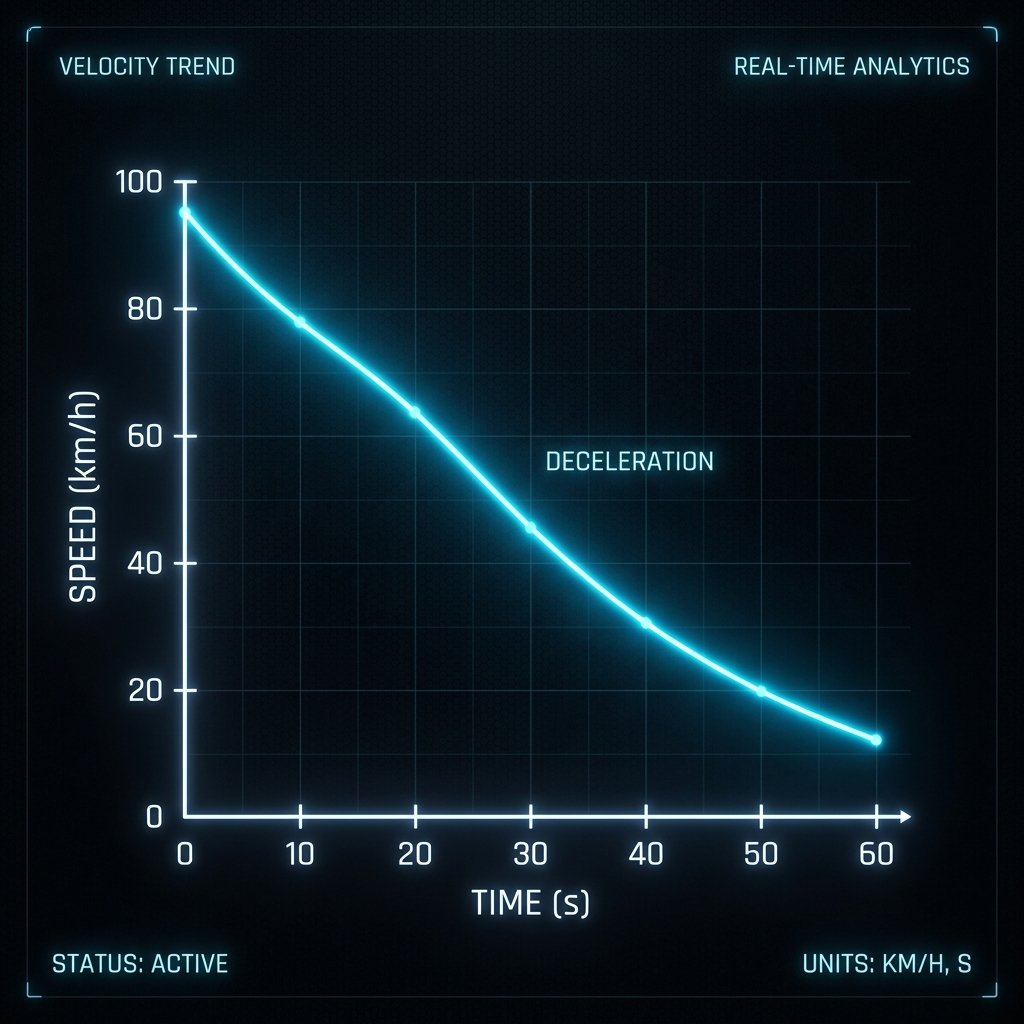
On a speed-time graph, the slope of the line represents acceleration (or deceleration/retardation if speed is decreasing). To calculate retardation:
The result is expressed as a negative acceleration, and the steeper the downward slope on the graph, the greater the retardation. This is a common calculation in physics coursework covering motion graphs, alongside calculating distance from a speed-time graph (which is done by finding the area under the graph line, not the slope).
How to Calculate Instantaneous Speed
How to Improve Your Own Calculation Speed
- Practice standard tricks daily (squaring numbers ending in 5, multiplying by 11, breaking multiplication into smaller parts) rather than cramming before an exam
- Time yourself on practice sets to build both speed and accuracy together, since fast-but-wrong defeats the purpose
- Learn Vedic math shortcuts, which are specifically designed to cut steps out of common calculations used in competitive exams like SSC, banking, and CAT
- Estimate before calculating exactly, which builds a sense for whether your final answer is in the right range
Try the Calculator
(Also looking for postal rates? Check our speed post charges calculator)