You’ve typed the question into a search bar more than once. Maybe it was after a friend’s wedding, maybe after a proposal that didn’t work out, or maybe it was just a slow Tuesday night with too much time to think. “When will I get married?” isn’t a small question. For a lot of people it sits somewhere between curiosity and genuine anxiety, especially once family starts asking every festival season.
This guide pulls together what Vedic astrology, numerology, palmistry and tarot each say about marriage timing, how the free calculators actually generate their answers, and where those tools fall short of a real consultation. You’ll walk away knowing exactly what to look at in your own birth chart, and what questions to ask before you trust any “when will I get married” prediction online.
What Does Astrology Say About When You’ll Get Married?
In Vedic astrology, the 7th house of your birth chart is the house of marriage and long-term partnership. It’s the single most-referenced factor across every marriage prediction method, and it’s the first thing an astrologer checks when someone asks about their wedding timeline.
The 7th house doesn’t work alone, though. Astrologers also study the 7th house lord (the planet that rules that house), any planets sitting inside it, and how those planets are aspected by others. A strong, well-placed 7th house lord generally points to a marriage that arrives on a fairly typical timeline. A weak or afflicted one often means delay, not denial — a distinction that matters a lot to someone who’s been told their chart shows “no marriage.”
Three supporting houses come into the analysis too. The 2nd house (family and accumulated wealth) shows what your married life adds to your finances and household. The 4th house (domestic happiness) shows the emotional tone of the home you’ll build. The 5th house (romance) is checked separately when someone specifically wants to know about a love marriage rather than an arranged one.
There’s also the 8th house, which astrologers check for a different reason: it governs longevity of the marriage and, in some readings, hidden or unconventional aspects of the relationship. A heavily afflicted 8th house doesn’t typically change when marriage happens, but it’s sometimes flagged as worth watching for long-term stability once the marriage is underway.
None of this happens in isolation from timing. A chart can show a happy, stable marriage and still need the right planetary period to activate it — which is where Dasha analysis comes in, covered a little further down.
The Planets That Decide Your Marriage Timing
Four planets carry most of the weight in a Vedic marriage prediction. Here’s what each one does:
- Venus (Shukra) — the natural significator of love, romance and marital happiness in every chart, but especially important in a man’s chart, where it represents the wife.
- Jupiter (Guru) — represents expansion, blessings and, in a woman’s chart, the husband. A well-placed Jupiter often correlates with marriage happening in a favorable, well-timed period.
- Saturn (Shani) — the planet of commitment, patience and delay. Saturn doesn’t block marriage; it tests readiness first, which is why Saturn-dominant charts often show later, more stable marriages rather than early, impulsive ones.
- Mars (Mangal) — when poorly placed, Mars creates what’s known as Mangal Dosha or Kuja Dosha, a much-searched topic covered in its own section below.
If any of these four are combust (too close to the Sun), debilitated (in a weak sign), or retrograde at the time of your birth, astrologers usually flag a possible delay rather than an absence of marriage. That distinction gets lost in a lot of one-line online reports, and it’s one of the most common reasons people walk away from a free calculator more anxious than when they started.
How Marriage Timing Is Calculated From Your Date of Birth
This is the part most calculators skip over, and it’s genuinely the most interesting piece of the whole system. Vedic astrology uses something called the Vimshottari Dasha to time events, marriage included. Here’s the basic process:
- Your Moon’s position at birth determines which planetary period, or Dasha, you’re born into. Each of the nine grahas rules a Dasha of a fixed length — Venus rules for 20 years, Jupiter for 16, Saturn for 19, and so on.
- Your birth chart is checked for connections to the 7th house. Astrologers look for which planet either rules, occupies, or aspects the 7th house.
- The Dasha and sub-Dasha (Antardasha) periods are mapped against your age. Marriage is considered most likely when the Dasha or Antardasha lord has a direct link to the 7th house.
- Current transits are layered on top. Jupiter’s transit through your 7th house, or over your Venus, is treated as a particularly strong marker of a marriage year.
This is why two siblings from the same family, raised in near-identical circumstances, can marry at 23 and 32 respectively according to their charts. It isn’t randomness from the astrologer’s point of view — it’s two different Dasha sequences unfolding on two different timelines. A free online tool that only asks for your zodiac sign can’t run this calculation at all; it needs your exact birth date, time and place to build an accurate chart.
Reading Your Kundli and Navamsa Chart for Marriage
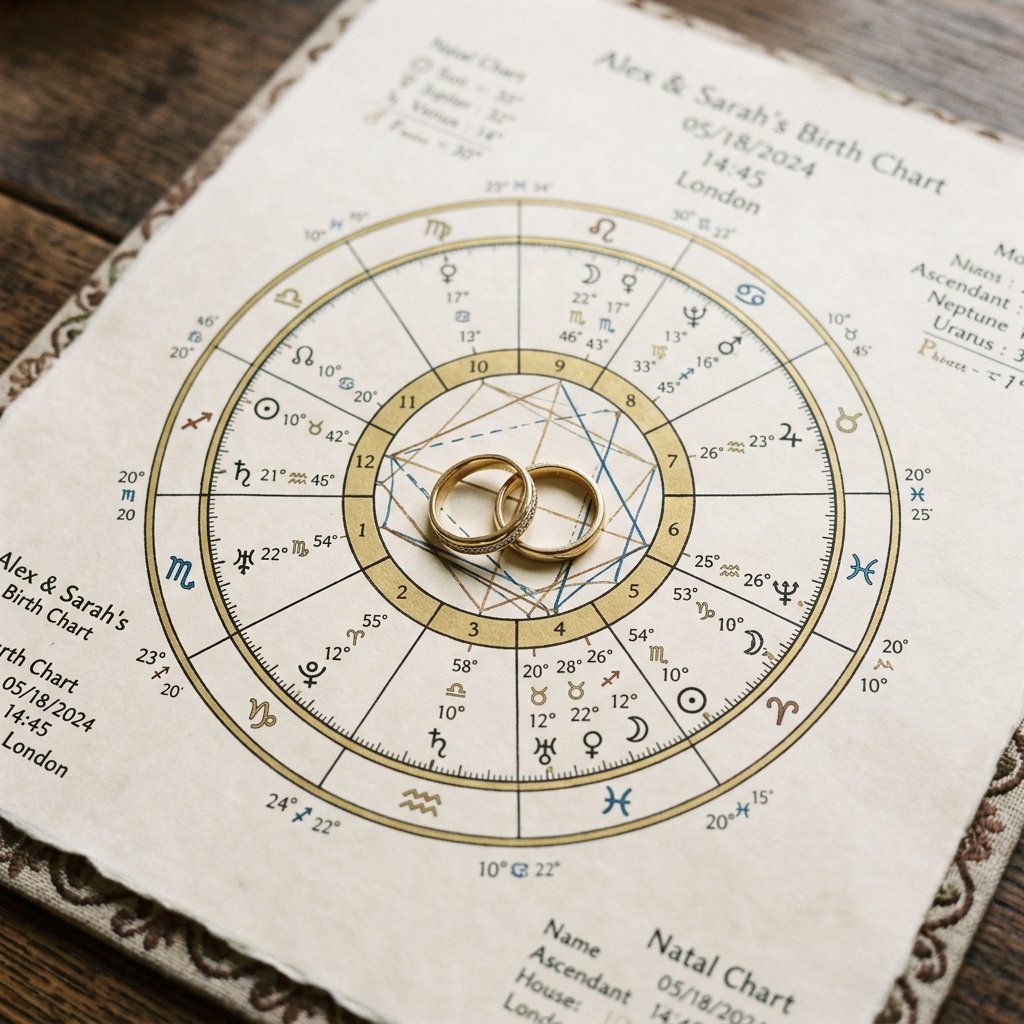
Your kundli (birth chart) is the primary document, but a serious marriage reading also involves the Navamsa chart (D9), a divisional chart specifically used to examine marriage and spousal matters in more depth than the main chart allows.
If a planet is weak in your main chart but strong in the Navamsa — a condition called Vargottama — it often signals that the marriage-related promise of the chart is stronger than it first appears. Astrologers also check whether the 7th house lord is in a dual sign (Gemini, Virgo, Sagittarius or Pisces), which is traditionally associated with a higher chance of more than one significant relationship or, in some readings, a second marriage.
A full kundli-based marriage prediction typically covers:
- The general age range in which marriage is likely
- Whether the chart leans toward a love marriage or an arranged one
- Broad personality traits of the future spouse
- Any doshas (planetary afflictions) that need remedies before or around the wedding
This is more thorough than what a name-and-birthdate calculator can produce in a few seconds, which is worth keeping in mind before treating a free result as final.
What Numerology Says About Your Marriage Age
Numerology takes a completely different route to the same question. Instead of planetary positions, it reduces your birth date to a single core number and looks for patterns in how that number interacts with life events over time.
The basic method: add the digits of your full birth date down to a single number (for example, 15 March 1994 becomes 1+5+0+3+1+9+9+4 = 32, then 3+2 = 5). That resulting number is checked against known “marriage year” cycles — years that share a numerological resonance with your core number tend to be flagged as favorable for major relationship commitments.
Numerologists also look at your Life Path Number alongside your partner’s, when one is available, to gauge compatibility separately from timing. It’s worth being clear-eyed here: numerology doesn’t have the same structured, centuries-old timing framework that Vedic Dasha analysis does, so most numerology-based “marriage age” tools should be treated as a lighter, more exploratory take rather than a precise forecast.
Palmistry and the Marriage Line
If you’ve ever had someone examine your palm and point to a faint horizontal line just below your little finger, that’s the marriage line, sometimes called the heart line’s companion or the relationship line, on the outer edge of the palm.
A few commonly cited palmistry patterns:
- A single, clear, unbroken line is traditionally read as indicating one stable, long-term marriage.
- Multiple faint lines are often interpreted as multiple significant relationships, not necessarily multiple marriages.
- The line’s distance from the base of the little finger is sometimes used to estimate approximate age — a line closer to the finger suggesting an earlier marriage, one closer to the heart line suggesting a later one.
- A line that forks at the end is associated by some palmists with separation or a major turning point within the marriage.
Palmistry is one of the older, more accessible methods precisely because it needs no birth data — just a clear look at your hand — which is part of why “how to know when will i get married palm reading” remains a common search on its own.
Can Tarot Cards Predict When You’ll Get Married?
Tarot approaches the question through symbolism rather than fixed timing systems, which makes it feel more personal to a lot of people, even if it’s less structured. A typical marriage-focused tarot spread pulls three to five cards representing your current relationship energy, obstacles ahead, and the general timeframe in which change is likely.
Cards commonly associated with marriage and commitment include:
- The Lovers — a strong indicator of a meaningful romantic choice or union on the horizon
- The Four of Wands — closely tied to celebration, weddings and formal commitment
- The Two of Cups — mutual attraction and a genuine partnership forming
- The Empress or The Sun — generally read as favorable, growth-oriented timing for love
Tarot readers are usually upfront that the medium works better for tone and direction than for pinning an exact month or year. If you’re specifically chasing a date, tarot is best combined with astrology rather than used on its own.
Free Calculator vs. Professional Astrology Consultation
Every free “when will I get married” tool online works from the same basic input: your date of birth, sometimes your name, occasionally your birth time and place if it’s a more serious astrology site. What it does with that input varies enormously in quality.
| Feature | Free Online Calculator | Professional Astrology Consultation |
|---|---|---|
| Input required | Birth date, sometimes name only | Exact birth date, time, and place |
| Chart depth | Often generic, sign-based | Full birth chart plus Navamsa (D9) |
| Dasha analysis | Rarely included | Standard practice |
| Output | Instant, generic percentage or short note | Personalized report or live discussion |
| Cost | Free | Typically paid, per session or report |
| Best for | Quick curiosity, entertainment | Genuine planning, delay concerns, remedies |
Neither option is “wrong” — they just answer different needs. If you’re mildly curious on a slow afternoon, a free calculator scratches that itch fine. If marriage delay is causing real stress in your life, or your family is pushing for answers you don’t have, a proper consultation that actually maps your Dasha periods will give you something far more useful to act on.
Common Reasons for Marriage Delay in Astrology
Delay is one of the most searched-around topics in this space, and for good reason — it’s the outcome most people are actually worried about when they ask this question. A few of the most commonly cited causes:
Mangal Dosha (Kuja Dosha). This occurs when Mars sits in the 1st, 2nd, 4th, 7th, 8th or 12th house of the birth chart. It’s traditionally associated with friction, impatience or conflict in married life, and in more conservative astrology practice, it’s checked carefully before finalizing a match between two charts.
A debilitated or combust Venus or Jupiter. When either significator planet is weakened, the astrologer typically expects a later marriage rather than a blocked one — timing shifts, the promise usually doesn’t disappear.
An unfavorable running Dasha. Even a strong chart can show delay if the current Mahadasha or Antardasha has no real connection to the 7th house. In these cases, astrologers often say the marriage is “waiting on the right period,” which tends to arrive once a more favorable Dasha begins.
Saturn’s influence. Saturn transiting the 7th house or aspecting key marriage significators is one of the most frequently cited delay factors, though it’s also linked to marriages that, once they happen, tend to be unusually stable.
Remedies suggested for these delays vary by tradition and astrologer — from specific mantras to gemstone recommendations to lifestyle adjustments — and are generally meant to strengthen a favorable period rather than override the chart altogether.
Signs Your Marriage Is Astrologically Approaching
Beyond the birth chart itself, astrologers watch for specific transits that tend to cluster around actual marriage events. None of these guarantee a wedding on their own, but together they’re treated as a meaningful signal that a favorable window has opened.
Jupiter transiting your 7th house or your natal Venus. This is probably the single most-cited transit in marriage astrology. Jupiter moves through each sign for roughly a year, so when it lands on your 7th house or conjuncts your Venus, that year is often flagged as favorable for engagements and weddings.
Venus becoming strong by transit or direction. A Venus that’s moved out of combustion, out of debilitation, or into a friendly sign is read as removing one of the more common technical blocks to marriage timing.
The Antardasha shifting to a planet connected with the 7th house. Even within a longer Mahadasha that isnt obviously marriage-focused, a two-to-three-year Antardasha period ruled by your 7th house lord, or by Venus or Jupiter, is often the actual window astrologers point to.
Saturn completing a hard aspect or transit. Counterintuitively, the end of a difficult Saturn transit — rather than its beginning — is sometimes read as clearing the way for commitment, since Saturn’s lessons are considered “done” by that point.
If you’ve had a reading before and were given a rough age range, these are generally the transits an astrologer is watching to narrow that range down to an actual year.
Marriage Prediction Traditions Across Indian Astrology Systems
Vedic astrology isn’t a single monolithic practice — regional traditions across India approach marriage prediction with some real differences in method and emphasis, which is part of why searches for this topic often specify a language or region.
North Indian and Hindi-belt astrology tends to lean heavily on the Vimshottari Dasha system described earlier, alongside Lal Kitab remedies for delay-related doshas. Lal Kitab, a distinct astrological tradition popular across North India, offers its own simplified remedies — often household items or specific actions — for marriage delay, separate from the mantra and gemstone remedies more common in classical Vedic practice.
Tamil and South Indian astrology places particular weight on nakshatra (birth star) matching, both for marriage timing and for compatibility once a potential match is identified. The concept of “porutham” — a structured points-based compatibility check between two nakshatras — is central to how Tamil astrology approaches marriage decisions, distinct from Vedic timing analysis alone.
Telugu and Kannada traditions follow a broadly similar structure to Tamil astrology but with regional variations in how doshas are weighted and which remedies are recommended first.
Bengali astrology shares the core Vedic framework but often incorporates a stronger emphasis on the Moon sign (Rashi) over the Ascendant (Lagna) when discussing timing, a distinction that occasionally produces a slightly different reading of the same birth data.
None of these traditions contradict each other so much as they emphasize different layers of the same underlying system. If you’re consulting an astrologer, it’s worth asking which tradition they practice in, since the terminology and remedy suggestions can otherwise be confusing to cross-reference.
A Worked Example: Reading a Sample Chart
It helps to see the process applied rather than described abstractly. Consider a hypothetical person born in early October, with Venus as the ruling planet of their 7th house, currently running a Jupiter Mahadasha that began three years ago.
Here’s how an astrologer would typically walk through this:
- Check the 7th house lord’s strength. Venus, ruling the 7th house, is found to be in its own sign — a strong, comfortable placement rather than a debilitated one.
- Check the current Dasha for a marriage connection. The active Jupiter Mahadasha doesn’t rule the 7th house directly, but Jupiter is well-placed and forms a supportive aspect to Venus.
- Look for the specific activating Antardasha. Within this Jupiter Mahadasha, the person is due to enter a Venus Antardasha in roughly a year and a half — since Venus is the 7th house lord, this sub-period is flagged as the most likely marriage window.
- Layer in current transits. If Jupiter’s slow transit is also due to cross this person’s natal Venus around the same time the Antardasha begins, the astrologer would treat that overlap as a particularly strong confirmation.
The output isn’t “you’ll marry on this exact date,” but something closer to: “the eighteen-month window starting when your Venus Antardasha begins looks like your strongest period for marriage, based on both your Dasha sequence and the transits landing during it.” That’s a meaningfully more specific and actionable answer than a generic online calculator can produce from a birth date alone — and it illustrates why birth time and place matter so much to the accuracy of any reading.
What About a Second Marriage?
Astrology does address remarriage as its own distinct area of analysis, separate from first-marriage timing. A few chart indicators commonly cited:
- A 7th house lord placed in a dual sign (Gemini, Virgo, Sagittarius, Pisces) is one of the more frequently mentioned indicators associated with the possibility of more than one significant marriage-related event.
- Multiple planets afflicting the 7th house, rather than just one, is sometimes read as indicating instability in the first union specifically, as distinct from delay.
- The 9th house from the 7th house (effectively the 3rd house of the main chart) is checked by some traditions specifically for second-marriage timing, following the same Dasha-based logic used for the first.
As with everything else in this guide, these are tendencies an experienced astrologer weighs against the rest of the chart, not standalone rules that apply the same way to everyone.
To Whom Will I Get Married? What Your Chart Suggests About Your Partner
Alongside timing, a lot of people specifically want to know about the who, not just the when. A few chart elements astrologers reference for this:
- The sign and condition of the 7th house lord often correlates with the general temperament of the future spouse — a fire-sign influence suggesting someone energetic and assertive, a water-sign influence suggesting someone more emotionally attuned, and so on.
- Venus’s placement (for men) or Jupiter’s placement (for women) is checked for clues about the partner’s background, appearance and general nature.
- The 7th house sign itself sometimes points to whether the partner is likely to come from a similar background and community, or a notably different one.
- Planets in the 7th house — if Rahu or Ketu are present, some traditions read that as pointing toward an unconventional match, possibly someone from a different culture, caste or geography.
This part of a reading tends to be broader and more interpretive than the timing analysis, and most credible astrologers will frame it as tendencies rather than certainties.
How Accurate Are Free Online Marriage Predictions?
Worth being honest about this rather than overselling it. A free calculator that only asks for your name and birth date, with no birth time or place, cannot construct an accurate 7th house or run a real Dasha calculation — those require your exact chart. What it usually produces instead is a generalized result based on your zodiac sign or numerology number, which explains why the same person can get noticeably different answers from three different free tools in the same afternoon.
That doesn’t make these tools worthless. They’re genuinely useful for:
- Getting a lighthearted, low-stakes sense of the topic
- Learning the basic factors (7th house, Venus, Jupiter, Dasha) that a real reading would examine
- Deciding whether the topic is worth a deeper, paid consultation
Where they fall short is anything involving genuine anxiety, family pressure around a specific age, or a real decision about remedies. For those situations, a birth-time-based chart reading from an experienced astrologer will give you something considerably more reliable to work with.
How to Prepare for an Accurate Marriage Reading
If you decide a free calculator isn’t giving you enough to work with, a little preparation goes a long way toward getting a reading that’s actually useful rather than another generic report.
- Get your exact birth time, not an approximate one. A birth certificate or hospital record is the gold standard. Even a 15-20 minute error in birth time can shift your Ascendant and, with it, which house system the astrologer is working from — which changes the whole 7th house analysis.
- Know your birthplace down to the city. Astrologers use your birthplace’s coordinates to calculate house cusps accurately. “Somewhere in Maharashtra” isn’t precise enough; the actual city or town matters.
- Write down your specific question before the session. “When will I get married” is broad. “Will marriage happen in the next two years” or “why does my chart show delay” are narrower questions that tend to get more focused, useful answers in a limited consultation window.
- Ask which chart system the astrologer uses. Sidereal versus tropical zodiac, and which Ayanamsa (a technical adjustment used in sidereal astrology) is applied, can shift results slightly between practitioners. It’s a fair question to ask upfront, especially if you’re planning to compare readings from more than one source.
- Treat remedies as optional, not mandatory. A good astrologer explains what a suggested remedy is meant to address and why, rather than presenting it as the only path forward. Be cautious of any consultation that moves quickly toward expensive gemstones or repeated paid follow-ups before answering your original question.
- Cross-check big claims. If a reading tells you something dramatic — a very specific date, a warning about “no marriage” without nuance, or an unusually expensive remedy — it’s reasonable to seek a second opinion before acting on it. Most experienced astrologers won’t be offended by that; it’s a normal part of how the field works.
Where This Leaves You
Marriage timing sits at an interesting intersection of ancient calculation and modern impatience. Vedic astrology’s 7th house and Dasha system, numerology’s cyclical number patterns, palmistry’s marriage line, and tarot’s symbolic spreads all approach the same question from different angles — and none of them replace the actual, unpredictable work of meeting someone and choosing to build a life with them.
If you’re genuinely anxious about the timeline, the most useful next step isn’t another quick calculator. It’s a proper reading with your exact birth time and place, from someone who can actually walk you through your Dasha periods and explain what they mean for you specifically. Start there, and treat everything else — the free tools included — as interesting context rather than the final word. For fun, you can also check out our free love calculator or daily love horoscope to explore your romantic energy today!