Plug in the coefficients from any equation in the form ax² + bx + c = 0, and this quadratic formula calculator returns both roots instantly, whether they’re whole numbers, fractions, decimals, or complex numbers. No sign-up, no app download, no ads interrupting your work — just the answer, plus the full step-by-step math underneath it so you can see exactly how the calculator got there.
Quadratic equations show up everywhere, from a ninth-grade algebra worksheet to a physics problem about a ball thrown off a rooftop to a business model that estimates when profit turns into loss. Most people don’t need to memorize a derivation to use the formula correctly; they need a fast, accurate way to get from “here’s my equation” to “here’s my answer,” and a clear enough explanation that the process actually sticks for the next test or the next problem set.
That’s what this page is built for. Below, you’ll find how to use the calculator, how the quadratic formula works and where it comes from, worked examples with real and complex roots, a breakdown of the discriminant, the other methods for solving quadratics, real-world applications, and answers to the questions people ask most often about this formula.
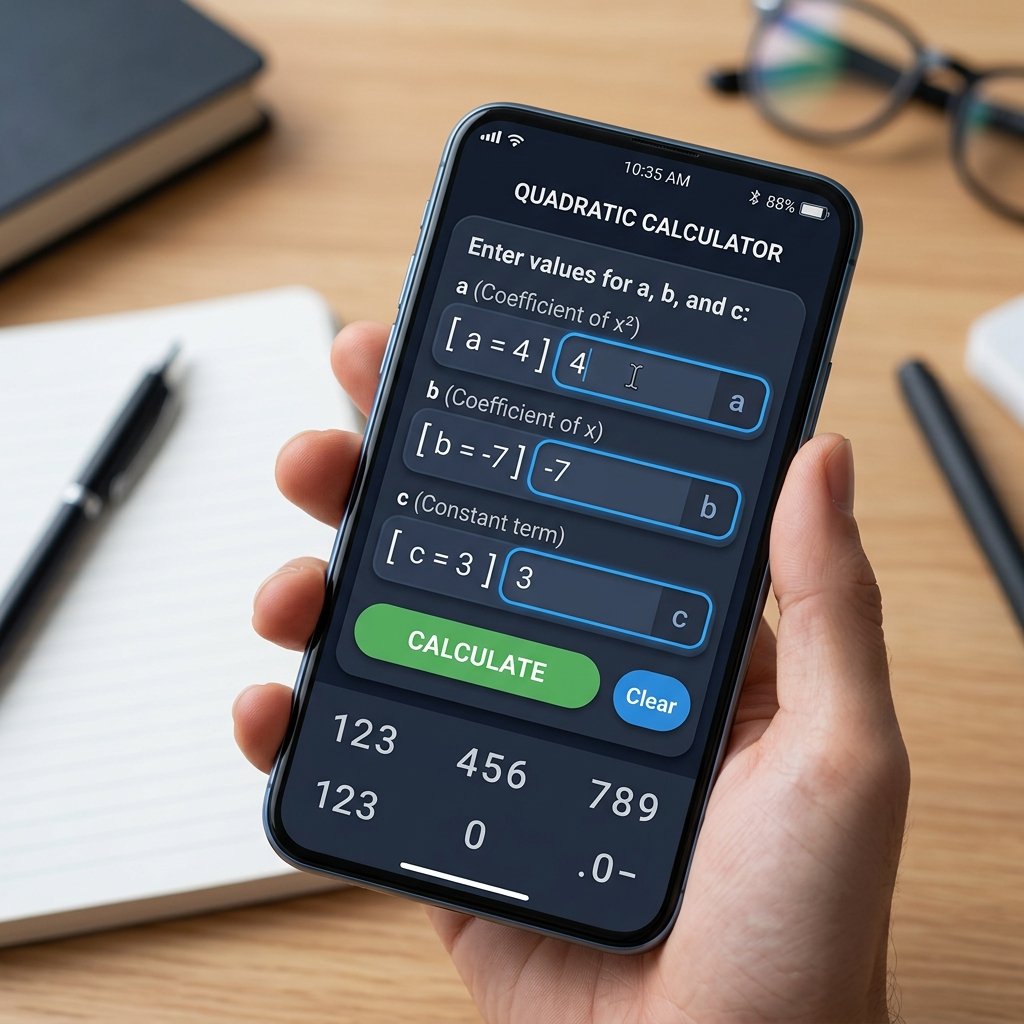
Enter your coefficients to solve instantly
What Is a Quadratic Equation?
A quadratic equation is a polynomial equation of degree two — meaning the highest power of the variable is x². Written in standard form, it looks like this:
Here, x is the unknown you’re solving for, and a, b, and c are known numbers called coefficients. The only strict rule is that a cannot equal 0 — if it did, the x² term would disappear and the equation would collapse into a linear equation instead of a quadratic one.
A few real examples of quadratic equations:
- x² − 5x + 6 = 0 (a = 1, b = −5, c = 6)
- 3x² + 2x − 8 = 0 (a = 3, b = 2, c = −8)
- −x² + 4 = 0 (a = −1, b = 0, c = 4)
Notice the last one has no b term. That’s still perfectly valid — b can be 0, c can be 0, but a never can.
What Is the Quadratic Formula?
The quadratic formula is the equation that solves any quadratic equation for x, no matter the values of a, b, and c:
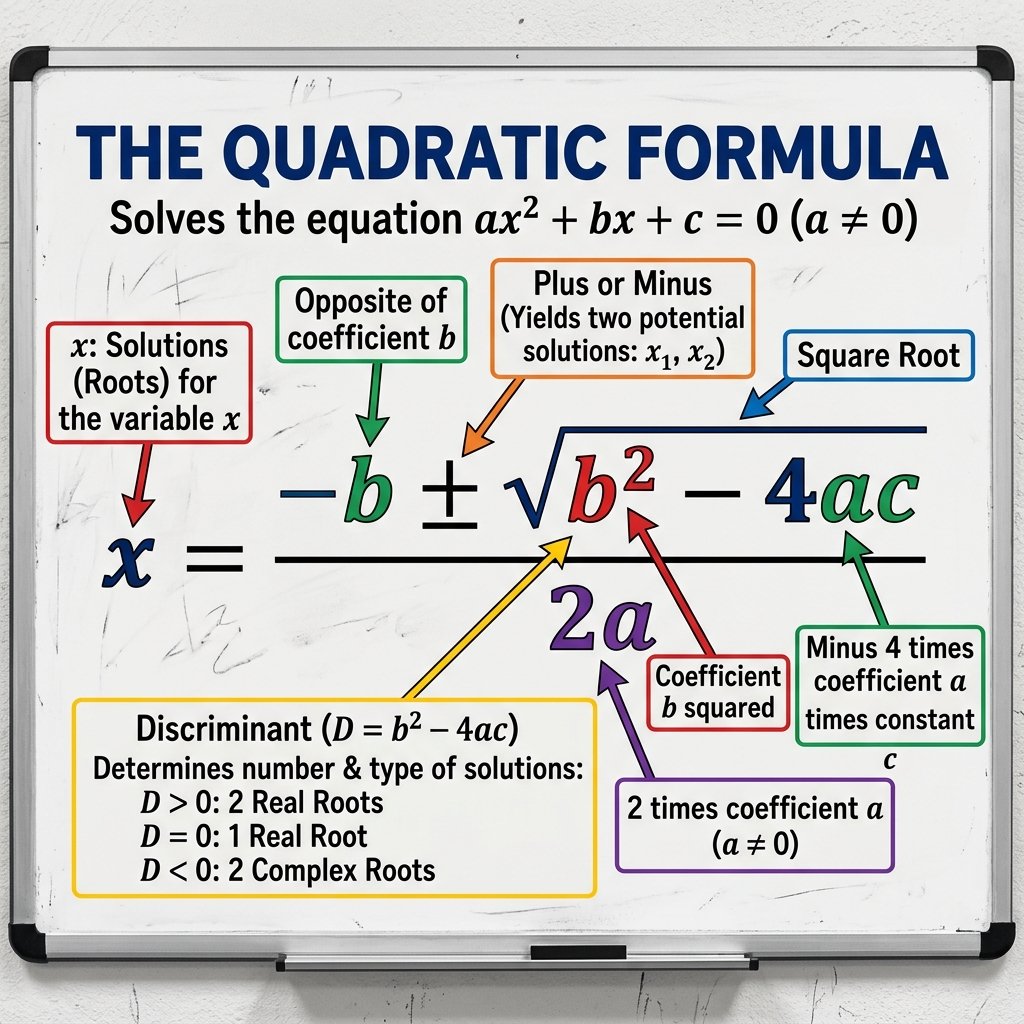
The quadratic formula, broken into its parts
The ± symbol means the formula actually produces two answers at once: one where you add the square root term, and one where you subtract it. Those two answers are called the roots of the equation — the values of x where the parabola described by the equation crosses (or touches) the x-axis.
Where the Quadratic Formula Comes From
The formula isn’t arbitrary; it’s derived by taking the general equation ax² + bx + c = 0 and completing the square. Here’s the short version of that derivation:
- Divide every term by a, so the equation starts with a plain x²: x² + (b/a)x + c/a = 0
- Move the constant to the other side: x² + (b/a)x = −c/a
- Add (b/2a)² to both sides to make the left side a perfect square trinomial
- Rewrite the left side as a squared binomial: (x + b/2a)² = (b² − 4ac) / 4a²
- Take the square root of both sides, then isolate x
Working through those five steps by hand every time you need to isolate a variable in the pattern that appears in every quadratic is what led mathematicians to package the result into one reusable formula instead of repeating the derivation from scratch each time. That packaged result is exactly what you’re plugging your a, b, and c values into above.
How to Use This Quadratic Formula Calculator
- Rearrange your equation into standard form, ax² + bx + c = 0, if it isn’t already.
- Identify the coefficients a, b, and c, keeping track of their signs.
- Enter those three values into the calculator.
- Read off both roots, along with the discriminant value and the full step-by-step work.
- If the discriminant is negative, the calculator returns complex roots in the form p ± qi instead of real numbers — that’s expected, not an error.
That’s the entire process. The calculator handles the arithmetic; the section below shows you what it’s doing under the hood, in case you’re solving by hand for a class or just want to double-check the logic.
How to Solve a Quadratic Equation by Hand Using the Quadratic Formula
Worked Example 1: Two Real Roots
Solve x² − 5x + 6 = 0.
Identify the coefficients: a = 1, b = −5, c = 6.
Substitute into the formula:
Simplify step by step:
- −(−5) = 5
- (−5)² = 25
- 4(1)(6) = 24
- 25 − 24 = 1
- √1 = 1
So x = (5 ± 1) / 2, which gives two answers: x = 6/2 = 3, and x = 4/2 = 2.
Check both by substituting back into the original equation: 3² − 5(3) + 6 = 9 − 15 + 6 = 0, and 2² − 5(2) + 6 = 4 − 10 + 6 = 0. Both check out.
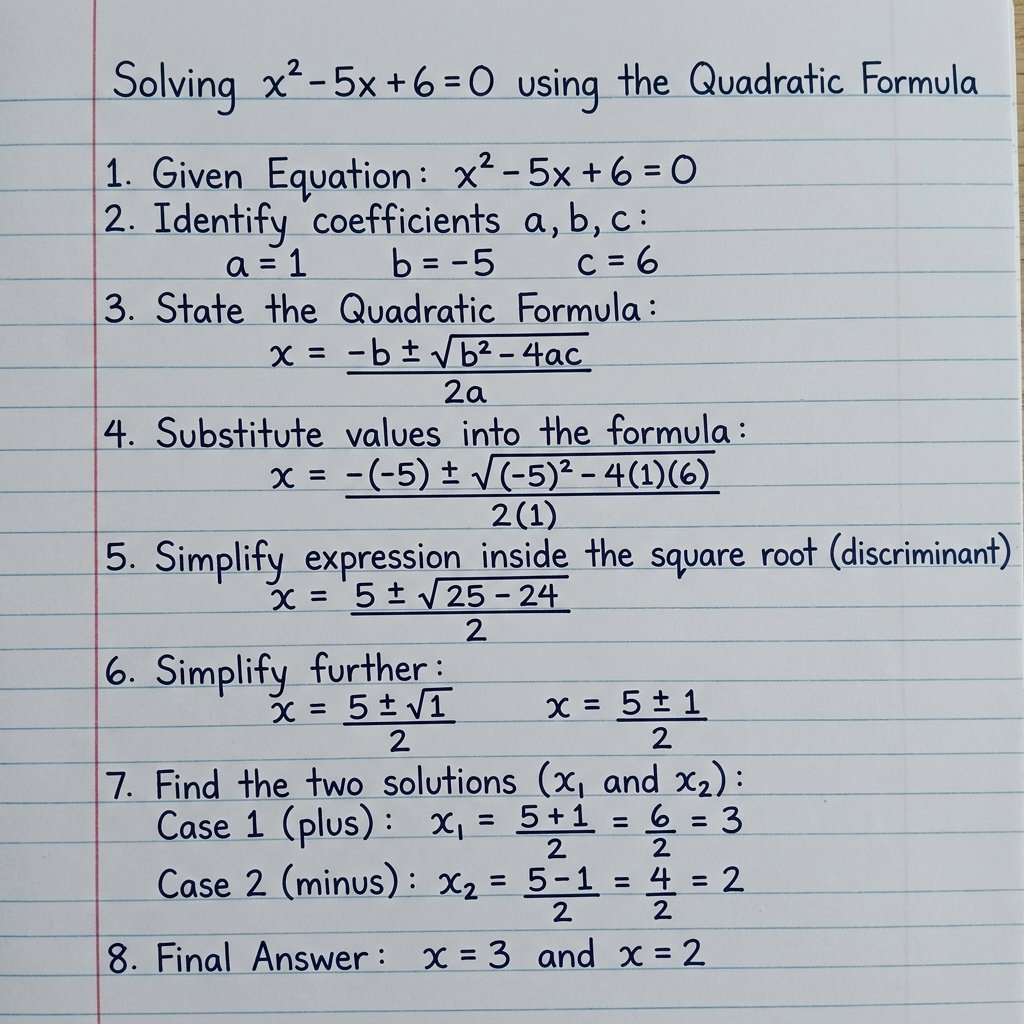
Solving x² − 5x + 6 = 0 step by step
Worked Example 2: Complex Roots
Solve x² + 4x + 8 = 0.
Coefficients: a = 1, b = 4, c = 8.
16 − 32 = −16, and the square root of a negative number isn’t a real number — it’s an imaginary one, written using i, where i = √(−1).
√(−16) = 4i
So x = (−4 ± 4i) / 2, which simplifies to x = −2 ± 2i.
That means the two roots are −2 + 2i and −2 − 2i. These are complex numbers, and they’re the correct, complete answer — the equation simply doesn’t cross the x-axis on a standard real-number graph, so its solutions live in the complex plane instead.
Understanding the Discriminant (b² − 4ac)
The expression under the square root sign, b² − 4ac, is called the discriminant. Its value tells you what kind of roots you’re about to get before you even finish the calculation.
| Discriminant value | What it means | Type of roots |
|---|---|---|
| b² − 4ac > 0 | Two distinct crossing points on the x-axis | Two different real roots |
| b² − 4ac = 0 | The parabola just touches the x-axis at one point | One repeated real root |
| b² − 4ac < 0 | The parabola never touches the x-axis | Two complex (imaginary) roots |
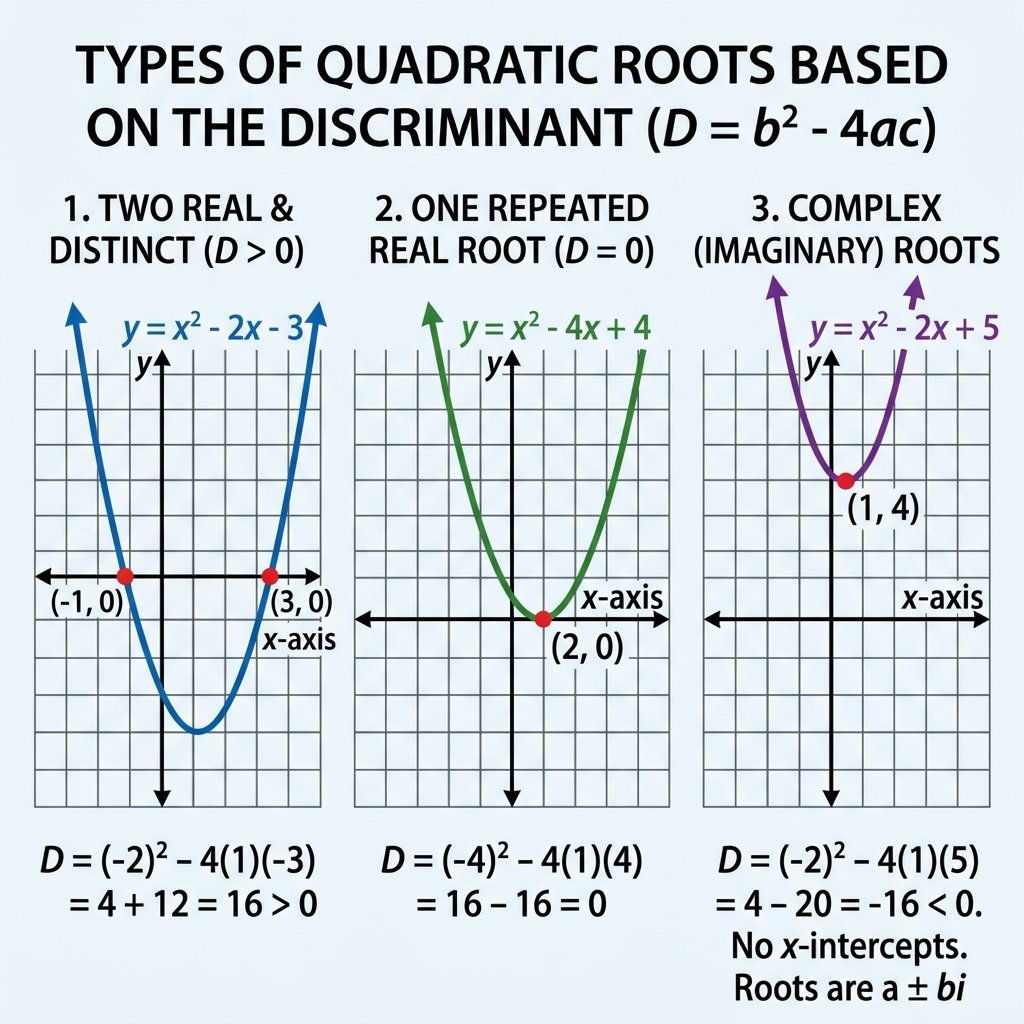
How the discriminant changes the graph
Checking the discriminant first is a useful habit, especially on a test: it tells you what your final answer should look like, so if you finish the problem and get a mismatched result, you know immediately where to go back and check your work.
Other Ways to Solve Quadratic Equations
The quadratic formula always works, on every quadratic equation, without exception — that’s its main advantage. But it’s not always the fastest tool for the job. Here’s how it compares to the other three common methods.
- Factoring — Rewriting the quadratic as a product of two binomials, like x² − 5x + 6 = (x − 2)(x − 3), then setting each factor equal to zero. Factoring is quick when the numbers are simple and the equation factors cleanly, but it doesn’t work (at least not with integers) when the roots are irrational or complex, and spotting the right factor pair takes practice.
- Completing the Square — Manipulating the equation into a perfect-square binomial, then taking the square root of both sides. It’s the technique the quadratic formula is built from, and it’s genuinely useful for converting a quadratic into vertex form, but it involves more steps than plugging into the formula directly.
- Graphing — Plotting y = ax² + bx + c and reading off where the curve crosses the x-axis. This is intuitive and helps build a visual sense of what “roots” actually mean, but it’s imprecise by hand and only shows real roots — a graph won’t reveal complex solutions.
- The Quadratic Formula — Works on every quadratic equation, real roots or complex, messy coefficients or clean ones, with no trial and error involved. The tradeoff is that it requires careful arithmetic, especially with the signs of b and the discriminant, which is exactly where a calculator like this one removes the risk of a small mistake.
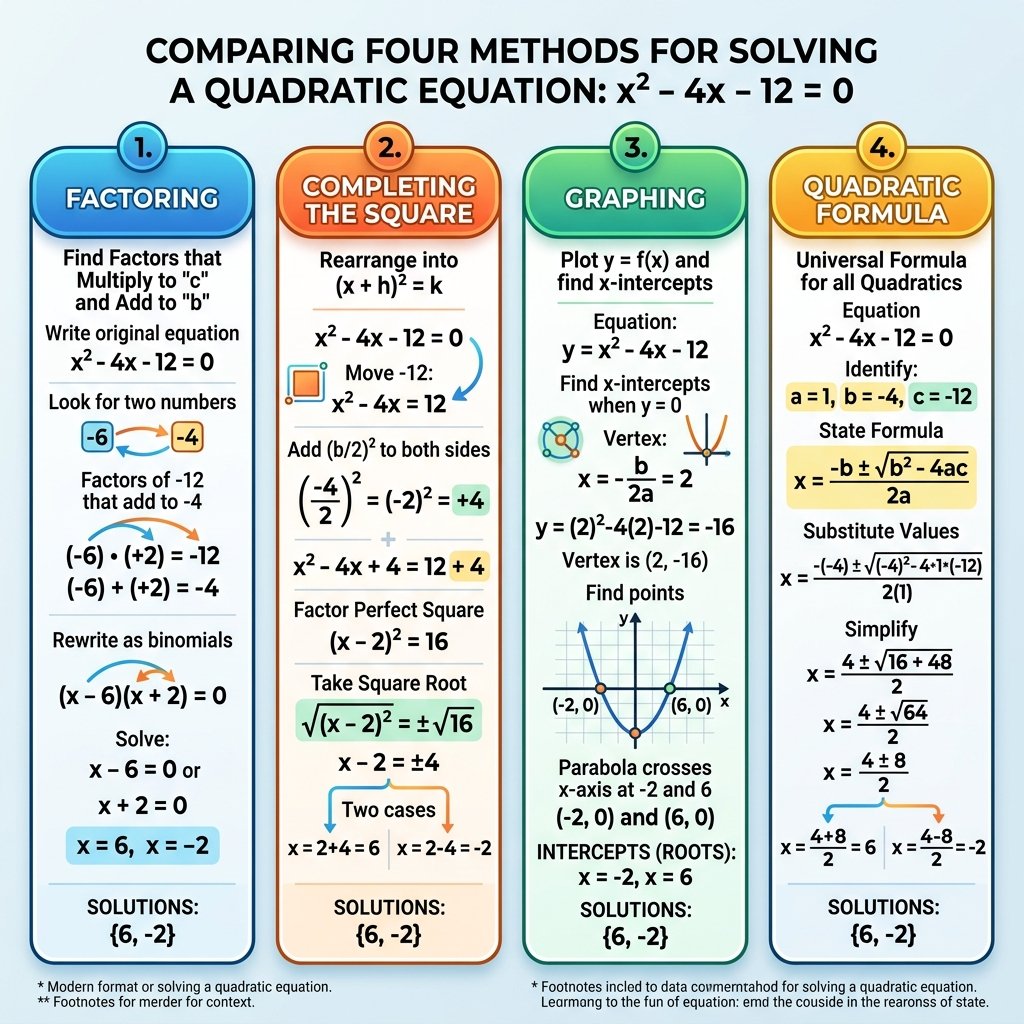
Four ways to solve a quadratic equation
Real-World Applications of the Quadratic Formula
Quadratic equations aren’t confined to a textbook. A few common places they show up:
- Projectile motion — The height of a thrown or launched object over time follows a quadratic equation, since gravity causes constant downward acceleration. Solving for when the object hits the ground (height = 0) is a direct quadratic formula application, common in physics coursework and in fields like sports science and ballistics.
- Area and dimension problems — If you know the area of a rectangular space and the relationship between its length and width, setting up and solving a quadratic equation gives you the actual dimensions.
- Business and profit modeling — Revenue and cost functions are sometimes quadratic, particularly when price affects the quantity sold. Finding the break-even points, or the price that maximizes profit, often comes down to solving a quadratic equation.
- Engineering and design — Parabolic curves appear in bridge cables, satellite dishes, and vehicle suspension design, where engineers need to calculate specific points along the curve.
- Optimization problems — Any time you’re looking for a maximum or minimum value of something that changes based on a squared variable, the vertex of a parabola (found using the same a, b, c values) gives you that peak or trough.
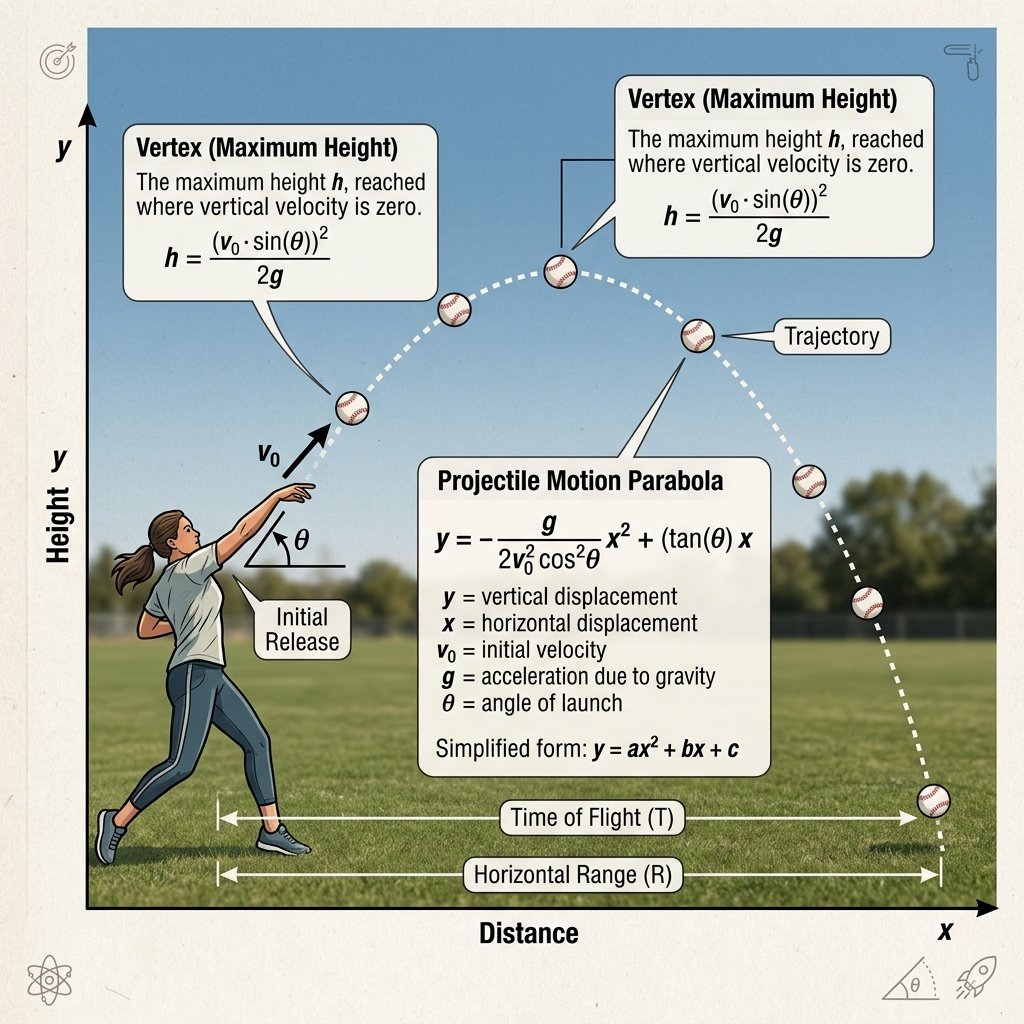
Quadratic equations model projectile motion
Common Mistakes When Using the Quadratic Formula
- Dropping a negative sign on b. If b = −7, then −b in the formula becomes 7, and b² becomes 49 regardless of the sign — a common slip is forgetting to square the negative correctly or mishandling −(−b).
- Forgetting the ± produces two answers, not one. Students frequently compute only the “+” branch and stop, missing half the solution.
- Rushing the discriminant calculation. b² − 4ac has to be computed fully before taking the square root; skipping straight to √b² − 4ac without the subtraction is a frequent arithmetic error.
- Not simplifying the final fraction. (5 ± 1)/2 simplifies cleanly to 3 and 2 — leaving the answer as an unsimplified fraction is technically correct but usually marked incomplete on schoolwork.
- Trying to force a negative discriminant into a real answer. A negative discriminant means the roots are complex, not “no solution” in every context — in physics or graphing terms it can mean “no real solution,” but mathematically the complex roots still exist and are often the required answer.
Quadratic Formula vs. Quadratic Function
These two terms get used almost interchangeably, but they’re not quite the same thing. A quadratic equation (like x² − 5x + 6 = 0) is a statement that something equals zero, and solving it gives specific x-values. A quadratic function (like f(x) = x² − 5x + 6) describes a relationship between x and y across every possible input, and graphing it produces the full parabola. The quadratic formula is the tool that solves the equation version — specifically, it finds the x-intercepts (roots) of the function version. In short: the function describes the whole curve; the formula finds where that curve crosses zero.
Tips to Remember the Quadratic Formula
A well-known trick for memorizing x = (−b ± √(b² − 4ac)) / 2a is singing it to the tune of “Pop Goes the Weasel” — it’s a genuinely common classroom mnemonic because the rhythm matches the formula’s syllables almost exactly. Beyond the tune, it helps to break the formula into three mental chunks: the −b out front, the discriminant under the square root (b² − 4ac), and the 2a underneath everything. Practicing with a few equations where a = 1 first, before moving to equations with larger or negative a values, also makes the pattern stick faster.
Who Discovered the Quadratic Formula?
There’s no single inventor. Babylonian mathematicians were solving quadratic-type problems using geometric methods as early as 2000 BCE, though not in the algebraic form used today. Centuries later, the Indian mathematician Brahmagupta provided one of the earliest known general solutions using something close to modern algebraic notation, and Bhaskara II refined that work further — which is why the formula is sometimes referred to as “Bhaskara’s formula” in Indian classrooms. The Persian mathematician Al-Khwarizmi, whose name is the root of the word “algebra,” also contributed systematic methods for solving quadratics geometrically. The compact symbolic version taught in classrooms today came together gradually through European mathematicians in the 16th and 17th centuries, as algebraic notation itself became standardized.
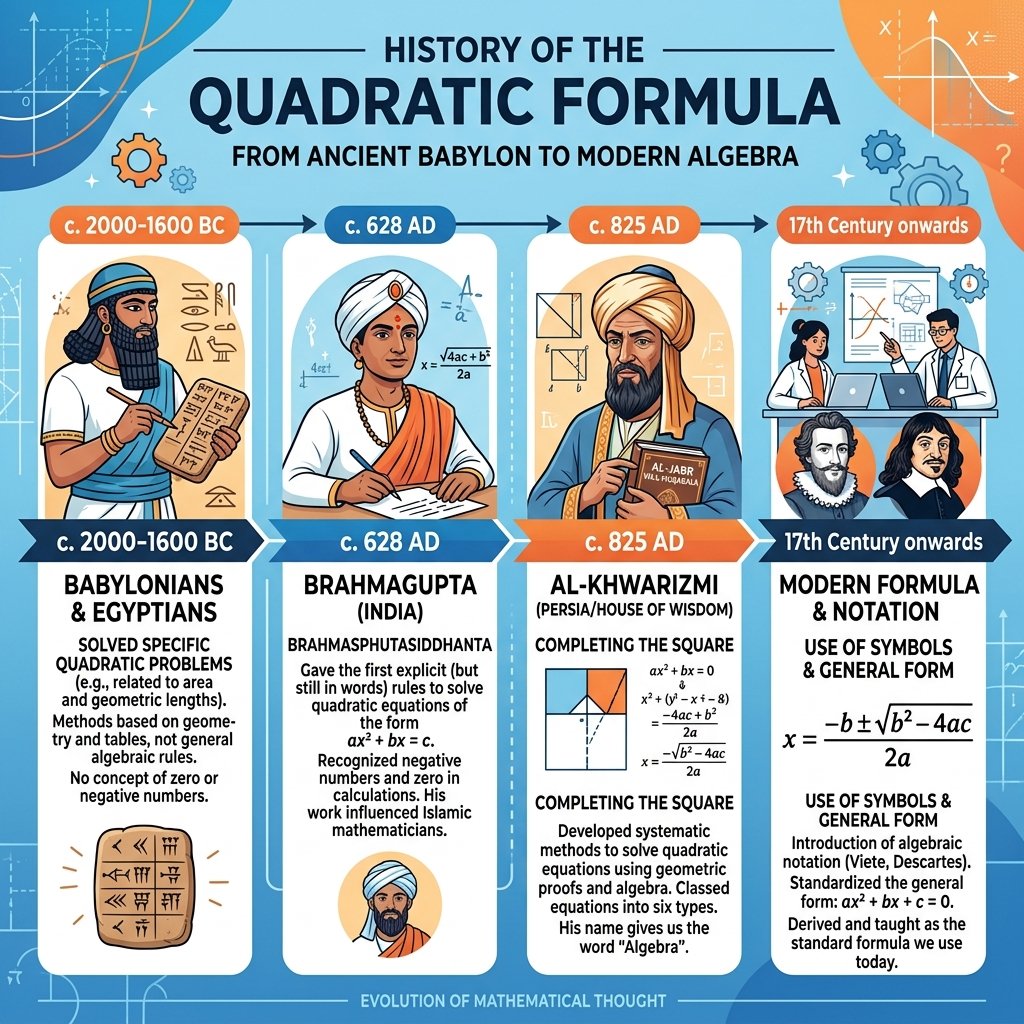
The quadratic formula’s centuries-long history
Frequently Asked Questions
The quadratic formula is x = (−b ± √(b² − 4ac)) / 2a. It solves any equation in the standard form ax² + bx + c = 0 for the value(s) of x, using the coefficients a, b, and c.
A quadratic equation is a second-degree polynomial equation, meaning the highest exponent on the variable is 2. Its standard form is ax² + bx + c = 0, where a cannot equal 0.
Rearrange it into standard form, identify a, b, and c, then either factor it, complete the square, graph it, or plug the coefficients into the quadratic formula. The quadratic formula is the only method guaranteed to work on every quadratic equation.
The discriminant, b² − 4ac, tells you how many real solutions an equation has before you finish solving it. A positive discriminant means two real roots, zero means one repeated real root, and a negative discriminant means two complex roots.
Every quadratic equation has exactly two solutions when you count complex numbers. If the discriminant is negative, there are no real-number solutions — meaning the graph never touches the x-axis — but there are always two complex solutions.
Roots and zeros refer to the same thing: the x-values that make the equation equal zero. “Roots” is more common in equation-solving contexts, while “zeros” is more common when talking about the graph of a function.
Always two, when complex numbers are included. Depending on the discriminant, those two solutions can be distinct real numbers, one repeated real number, or a pair of complex conjugates.
The axis of symmetry is the vertical line that splits the parabola into two mirror-image halves. Its equation is x = −b/2a, which is also the x-coordinate of the vertex, and notably the same expression that appears at the center of the quadratic formula.
Quadratics gets its name from the Latin word “quadratus,” meaning “square,” referring to squaring a number (raising it to the second power) — not to the number four. A degree-4 equation is called “quartic” instead.
Yes. When b² − 4ac is negative, the square root produces an imaginary number, and the final roots are complex numbers in the form p ± qi rather than real numbers.
If an equation is written as x² + bx + c = 0 with no visible number in front of x², then a = 1. The x² term is still there; the coefficient is just an implied 1.
Factoring is faster when it works cleanly, but not every quadratic factors nicely with whole numbers. The quadratic formula works on every quadratic equation without exception, which makes it the more reliable default, especially under time pressure.
If a = 0, the x² term disappears and the equation is no longer quadratic — it becomes a linear equation instead, solvable with simple algebra rather than the quadratic formula.
It’s used to calculate things like when a projectile hits the ground, the dimensions of a space given its area, break-even points in a business model, and the shape of parabolic structures in engineering and design.
The quadratic formula is derived from completing the square, but they’re used differently. Completing the square is a step-by-step process typically used to convert a quadratic into vertex form or to solve one specific equation manually, while the quadratic formula is a ready-made shortcut that skips straight to the answer.
The pq-formula is a simplified version of the quadratic formula used mainly in European (particularly German) math education, applied to a quadratic equation already in the form x² + px + q = 0, where a = 1. It produces the same answers as the standard quadratic formula, just with fewer terms to track since a is assumed to be 1.
No single person invented it. Babylonian mathematicians solved quadratic-type problems geometrically thousands of years ago, Indian mathematicians Brahmagupta and Bhaskara II developed early algebraic solutions, and Persian mathematician Al-Khwarizmi contributed systematic solving methods — the modern symbolic formula came together gradually over centuries as algebraic notation itself developed.
Solve Your Equation Now
Skip the manual arithmetic and the risk of a sign error. Enter your a, b, and c values into the calculator above and get both roots, the discriminant, and the full worked solution in seconds — free, with no account required.