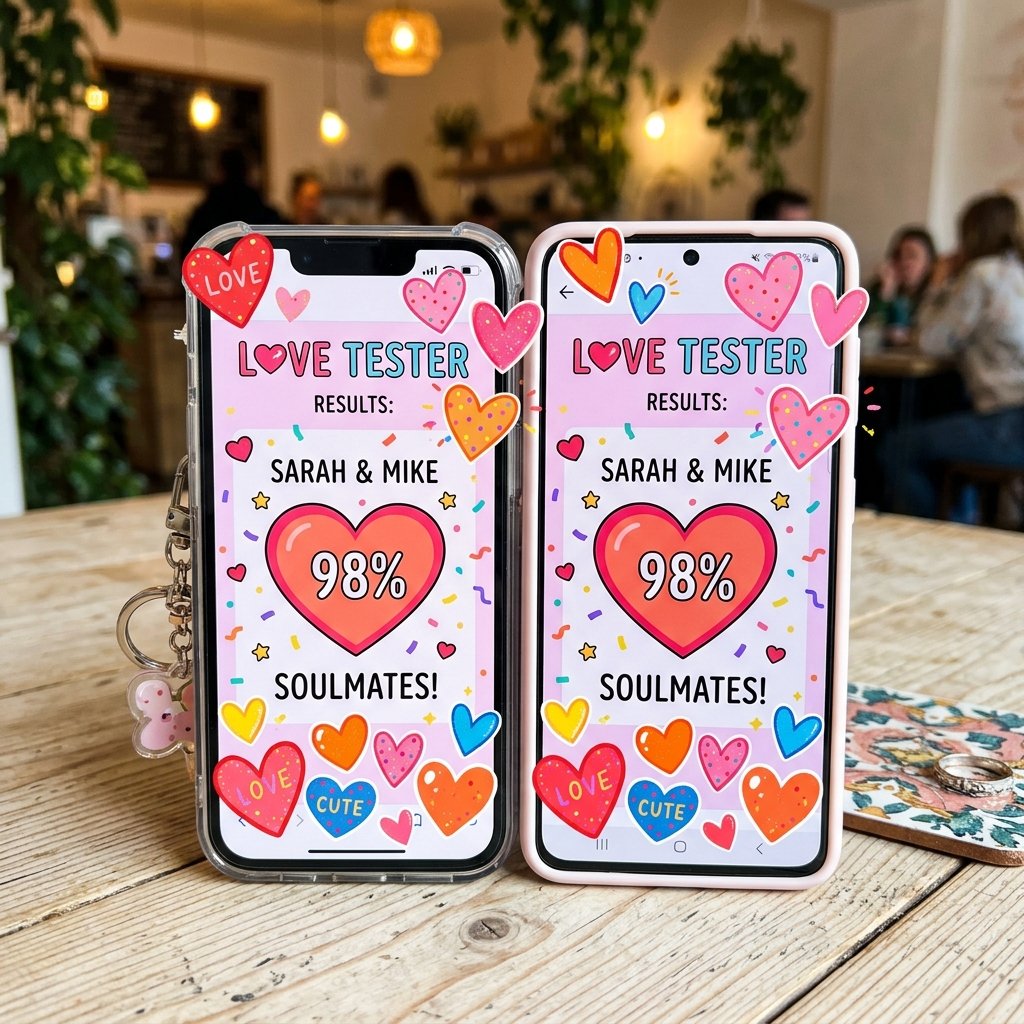
Type your name. Type theirs. Watch a number appear that claims to know something about your heart. That’s the entire pitch of a love tester, and somehow it still works on all of us — the skeptics included.
A love tester is a free online tool that takes two names and turns them into a compatibility percentage, usually somewhere between 0% and 100%. You’ve probably seen a version of it before: on a phone app, in a school computer lab, or as a booth at a fair that spat out a number when you gripped a metal handle. This page covers how the modern version works, how to use it, where the idea actually came from, and what a good compatibility score can and can’t tell you about a real relationship.
None of that means you should skip the fun. It means you’ll understand exactly what you’re looking at once your score shows up.
What Is a Love Tester?
A love tester is an online tool or game that generates a compatibility score between two people based on the names you enter. You type in your name and your crush’s name, hit a button, and get a percentage that represents your supposed “love match.”
The result is generated by an algorithm — usually one built on letter patterns, name length, or simple randomization seeded by the names themselves. Some versions add extra inputs like birth dates or zodiac signs for a more elaborate feel, but the core idea stays the same: enter two names, get a number, laugh or swoon depending on what shows up.
Love testers exist purely for entertainment. They’re not psychological instruments, and no credible relationship researcher would use one to predict whether a couple stays together. That’s not a knock against them — it’s just useful to know going in, the same way you’d know a fortune cookie isn’t a financial plan.
How to Use This Love Tester (4 Steps)
Using a love tester takes about ten seconds. Here’s the process:
- Enter your full name in the first box. Nicknames work too, and often change your score.
- Enter your crush’s name in the second box — first name, full name, or a nickname you use for them.
- Click “Calculate” to run the compatibility check.
- View your love percentage, then try different name spellings or full names if you want to see the score shift.
That’s the whole loop. Most people run it two or three times with small variations before they’re satisfied — swap a nickname for a full name, add a middle name, try it with an old crush for comparison. Each version can hand back a different number, which is part of what makes it replayable.
The Old-School Love Test on Paper (Before It Went Digital)
Long before anyone built a website for this, people were doing the exact same thing with a pen. If you’ve ever heard someone mention “the true love test on paper” or watched a version of it on TikTok, this is where it comes from.
The classic method uses the word LOVE or the phrase TRUE LOVE as the scoring key:
- Write both names side by side at the top of the page.
- Below them, write out the letters T-R-U-E and L-O-V-E (or just L-O-V-E for the shorter version).
- For each letter, count how many times it appears across both names combined, and write that number underneath the corresponding letter.
- Starting from the left, add each pair of adjacent digits together. If a sum is a two-digit number, split it into two separate digits and keep going.
- Keep adding pairs until only two digits remain. Read those two digits as your percentage.
A version of this — swap “LOVE” for the word “FLAMES” (Friends, Lovers, Affection, Marriage, Enemies, Siblings) — became its own game, popular across Indian and South Asian schools for decades before online love testers existed. Cross out matching letters between two names, count what’s left, then land on a letter in “FLAMES” that decides your fate as a couple.
The online love tester is really just this childhood notebook game, sped up and given a nicer interface. If you grew up scribbling names in the margins of a textbook, you were running the same basic algorithm this page automates in half a second.
A Short History: From Arcade Booths to Your Phone
Love testers are older than the internet by a good margin. Arcade “love meter” machines — sometimes called love tester machines — started showing up in penny arcades and amusement parks decades ago. You’d grip a metal handle, and the machine would claim to measure your “passion” or “sex appeal” through skin conductance, essentially the same tech used in a basic lie detector. Some machines were more honest about it and just used a random number generator dressed up as science.
Nintendo made its own tabletop version in 1969 called Love Tester, a simple electronic toy where two people held hands with a third person holding the device, and a needle swung across a dial to reveal a “love level.” It’s one of Nintendo’s earliest hardware products, built years before the company touched a video game console.
The idea migrated online sometime in the 2000s, dropped the physical hardware, and kept the same basic promise: put in some personal information, get a number, feel something about it. What changed is the input — hands and skin conductance became names and a text box — but the psychological hook stayed exactly the same.
Why We Keep Playing These Games
There’s a reason love testers have survived arcade machines, playground games, and three decades of the internet without ever really going away: they tap into something called the Barnum effect, the tendency to find vague, generalized statements personally meaningful. A love tester doesn’t need to be accurate to feel accurate. A 78% match with your crush feels like validation. A 12% match with your ex feels like proof you made the right call.
Add in the social layer — sharing results, comparing scores with friends, testing celebrity couples just to see what happens — and you get a tool that’s less about the actual number and more about the conversation it starts. Two friends testing their names against a mutual crush will talk for ten minutes about a result that took two seconds to generate. That gap between effort and social payoff is exactly why the format keeps getting rebuilt for every new platform.
There’s also a low-stakes safety to it. Asking someone out or admitting a crush directly carries real risk. Typing both your names into a free tool and getting a number carries none. It’s a way to sit with a feeling without having to say it out loud yet.
Love Tester vs. Other Compatibility Tools
Love tester isn’t the only name-based or fun compatibility format online. Here’s how it compares to the tools it’s most often confused with:
| Tool | Input Used | Best For | Depth of Result |
|---|---|---|---|
| Love Tester | Two names | Quick fun with a crush, friends, or celebrities | Single percentage, instant |
| Love Calculator | Two names (sometimes DOB) | Slightly more detailed name-based scoring | Percentage plus short description |
| Zodiac Compatibility | Birth dates / star signs | People interested in astrology | Sign-based compatibility summary |
| FLAMES / Paper Test | Two names, counted by hand | Group settings, no phone needed | Category result (Friends, Lovers, etc.) |
| 5 Love Languages Test | Multiple-choice questionnaire | Understanding how you express/receive love in a real relationship | Personality-style breakdown, not a % score |
The key difference to remember: love tester and its close cousins (love calculator, FLAMES, paper tests) are all novelty tools built around names. The Love Languages test is a completely different category — a real psychology-based framework from author Gary Chapman, meant to be taken seriously inside an actual relationship. If you’re looking for that instead, it deserves its own dedicated test rather than getting lumped in here.
Creative Ways to Use a Love Tester
Most people start with the obvious use case — testing themselves against a current crush — then branch out once they realize how flexible the tool is:
- Test celebrity couples. Are your two favorite actors, musicians, or influencers “meant to be” according to the algorithm? It’s a harmless way to settle a fan debate.
- Run it at a sleepover or party. Groups of friends testing each other’s names (and everyone’s crushes) tends to produce the loudest reactions in the room.
- Try nicknames vs. full names. The same two people can score completely differently depending on whether you use “Mike” or “Michael,” which is half the fun of running it more than once.
- Test fictional couples. Book characters, TV pairings, anime ships — if a fandom argument needs a tiebreaker, a love tester is a low-effort way to add fuel to it.
- Compare old and new. Testing a current crush against an old one can be a genuinely funny (or oddly clarifying) five minutes.
None of these uses require you to believe the science. They just require two names and a sense of humor.
Is Love Tester Accurate? What It Can (and Can’t) Tell You
Here’s the honest answer: no, a love tester’s score is not a real measurement of how compatible two people are. The algorithm behind it responds to letters, name length, or randomized seeding — not to how two people communicate, handle conflict, or actually feel about each other. A 14% match can exist between two happily married people, and a 96% match can appear between two names picked at random.
What it can tell you is something closer to entertainment value: it’s a prompt for conversation, a low-pressure way to bring up a crush, and a shared joke with friends. Treat the result the way you’d treat a fortune cookie or a magic 8-ball — fun to read, not something to build a decision on.
If you get a low score with someone you actually like, that number has no bearing on your real chances. If you get a high score with someone you’ve never spoken to, that’s not a green light either. The test measures names. Real compatibility measures something else entirely.
What Actually Predicts Compatibility (Beyond the Score)
If a love tester result gets you thinking seriously about a relationship, real compatibility research points to a handful of factors that matter far more than any name-based score:
Communication style. Couples who can raise a disagreement without it turning into a fight tend to last longer, according to decades of relationship research out of places like the Gottman Institute. How you argue matters more than whether you argue at all.
Shared values, not shared hobbies. You don’t need to like the same movies. You do need roughly aligned views on things like money, family, and how you want to spend your time.
Consistency over time. Someone who shows up the same way on a good day and a bad day is a stronger predictor of a lasting relationship than someone who’s intensely romantic in short bursts.
How conflict actually resolves. Not whether you fight, but whether fights end in repair — an apology, a compromise, a genuine “I hear you” — instead of silence or resentment that carries over.
None of that fits in a text box. It takes time, attention, and usually a few uncomfortable conversations. The love tester is the fun five-second version. This is the slower, real one.
Common Mistakes People Make With Love Tests
A few patterns show up again and again when people take these tests too seriously or use them the wrong way:
- Treating a low score as a verdict. The most common mistake by far. A 20% match doesn’t mean give up — it means the algorithm did what algorithms do with those specific letters.
- Testing obsessively to “find” a better number. Running the same two names through ten variations until one hits 90%+ says more about wanting a certain answer than it does about compatibility.
- Confusing it with the 5 Love Languages test. These are genuinely different tools solving different questions. One is a novelty name game; the other is a real framework for understanding how you and a partner express affection. Mixing them up leads to the wrong expectations for both.
- Using the result to make a real decision. Whether to ask someone out, whether to stay in a relationship, whether a friendship “should” become something more — none of that should ride on a number generated from letters in a name.
- Forgetting it’s meant to be shared. The best part of a love tester is running it with friends and laughing about the result together. Taking it alone and dead-serious skips the actual point of the tool.
Final Thoughts
A love tester will never tell you anything true about whether you and your crush are meant to be — and that’s fine, because that was never really the point. It’s a fast, low-stakes way to turn a crush into a conversation, a night with friends into a game, and a curious “what if” into something you can laugh about in ten seconds flat.
Enjoy the score for what it is. Then go build the real thing the slow way, with actual conversations instead of a text box.
Try the Love Tester now — enter two names and see your love percentage instantly.