You’ve probably scribbled this on the back of a notebook at least once. Two names, a string of crossed-out letters, and one word left standing that supposedly decided whether you and your crush were headed for Friendship, Love, or something else entirely. The FLAMES calculator below does the exact same thing, minus the eraser marks.
Type in your name and the other person’s, hit calculate, and you’ll get your result in seconds, along with the percentage strength behind it. Below the tool, this guide breaks down where FLAMES came from, exactly how the counting works, what each letter actually means, and how this differs from things like twin flame numerology or a general love calculator.
What is a FLAMES calculator?
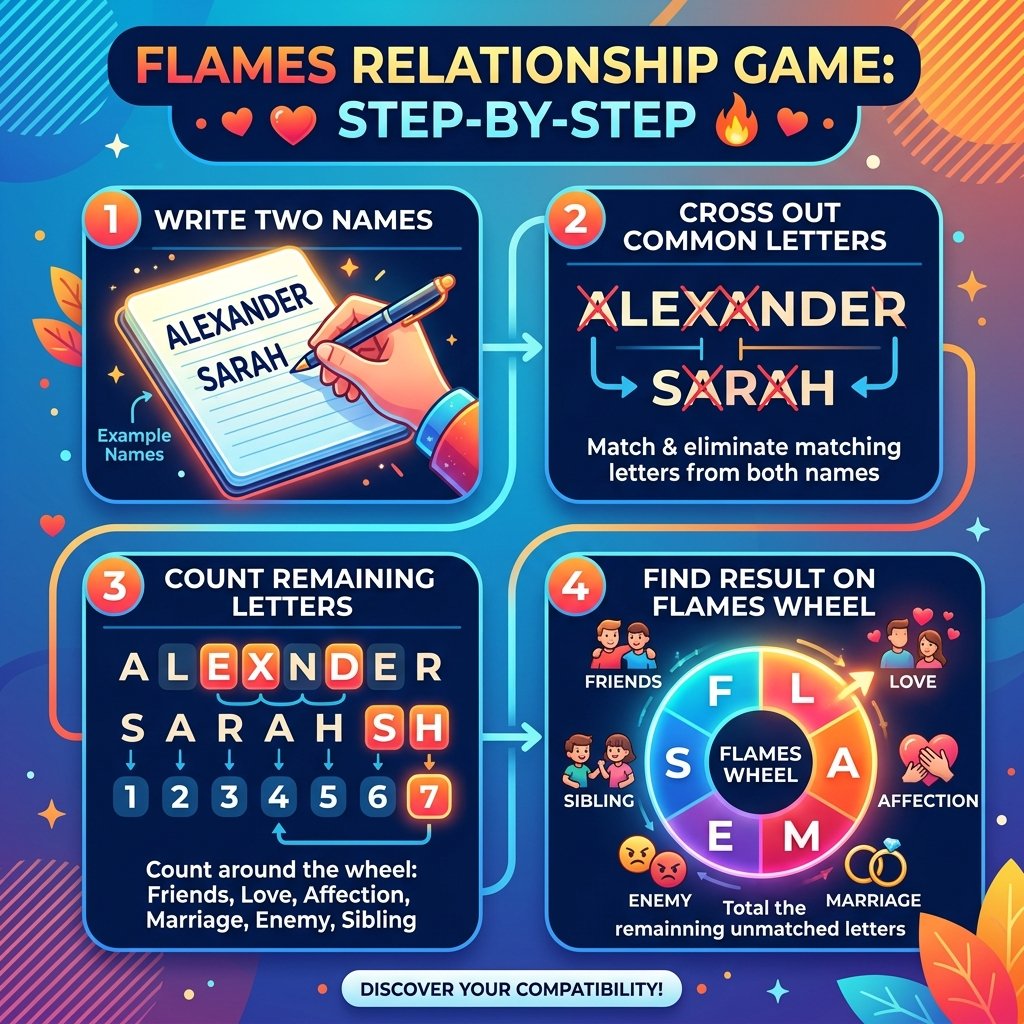
A FLAMES calculator is a digital version of the old classroom letter game that predicts the “type” of relationship between two people based purely on their names. FLAMES is an acronym: Friends, Love, Affection, Marriage, Enemies, Sibling. You enter two names, the tool cancels out the letters they share, counts what’s left, and cycles through those six letters until only one remains. That letter is your result.
It isn’t astrology, and it isn’t a personality test. It’s a counting puzzle dressed up as a fortune-telling game, and that’s exactly why it has stayed popular for decades. There’s no signup, no birth chart, no waiting. Two names go in, one word comes out.
Where the FLAMES game actually came from
Nobody owns FLAMES the way someone owns a board game. It spread the way most schoolyard games do, kid to kid, notebook to notebook, with no single inventor on record. Versions of it have circulated across Indian, Filipino, and other South and Southeast Asian schools for at least a couple of generations, which is part of why it feels instantly familiar to anyone who grew up doing “name matching” during a boring lecture.
What changed is the medium. The rules never needed updating. What needed updating was the counting, because doing it by hand for six or seven name pairs during lunch break gets tedious fast. An online FLAMES calculator just automates the same pencil-and-paper steps and returns the answer instantly, which is why searches for “flames calculator online” and “flames game how to calculate” both spike among the same audience: people who already know the game and just want the counting done for them.
How to calculate FLAMES: the manual method
Here’s the traditional pen-and-paper process, the one the calculator replicates automatically.
- Write both names in full. Use first names, or full names if you want a stricter result – nicknames will change the outcome.
- Cross out every matching letter. Go through both names and cancel one letter from each name for every match. If “R” appears in both names, cross out one “R” from each side, not every “R” in the entire name.
- Count what’s left. Add up the letters that were not crossed out across both names combined.
- Cycle through F-L-A-M-E-S using that count. Starting from F, count forward through the letters, looping back to F after S, and cross out whichever letter your count lands on. Repeat with the remaining letters until one is left.
- Read the final letter. That single surviving letter is your FLAMES result.
Quick example: Take “Rohan” and “Priya.” Cross out shared letters (there are none between these two names), so all 10 letters remain in play. Counting through F-L-A-M-E-S in a loop of 10 eventually leaves one letter standing, and that’s the result the calculator would display along with a percentage score showing how strong that match is.
The FLAMES formula, explained simply
The whole system reduces to two operations: subtraction and modular counting.
- Step one – subtraction. Every shared letter between the two names is removed, one letter from each name per match. This is where the “compatibility” idea technically comes from: names with more overlapping letters cancel more pairs and leave a smaller number behind.
- Step two – modular elimination. The remaining letter count determines how you cycle through the six FLAMES letters. If the count is, say, 13, you count 1 through 13 across F-L-A-M-E-S repeatedly, eliminating the 13th letter each pass, until one is left. Mathematically, this is a variant of the classic “Josephus problem,” the same elimination logic used in some scheduling and queueing algorithms, just applied to six items instead of a larger circle.
For anyone building their own version – a fair number of people search for “flames game code in python,” “flames calculator code,” or “c program for flames game” – the logic is short: build a string of the two names, strip matching characters, count what’s left, then simulate elimination around a list [“F”,”L”,”A”,”M”,”E”,”S”] using that count modulo the list’s shrinking length. It’s a solid beginner project for practicing string comparison and list manipulation, which is likely why it shows up so often in intro programming assignments.
Understanding your FLAMES percentage
Most modern FLAMES calculators, including this one, don’t stop at a single letter. They also show a percentage, a rough strength score for the result. This isn’t part of the original pen-and-paper game; it’s a newer addition built by measuring how many letters overlapped relative to the total length of both names combined. More overlap generally pushes the percentage up, since it signals the two names “cancelled out” more cleanly before the elimination round even started.
Treat the percentage the same way you’d treat the letter itself: as a fun add-on, not a verified compatibility score. It gives you something more granular to compare when you’re testing multiple name pairs, which is a big part of why it’s become a common feature request.
What each FLAMES letter means
F – Friends: A steady, low-drama bond built on trust and comfort rather than romance. Good company, easy conversation, no pressure. L – Love: Points toward romantic attraction and emotional pull. The classic result people are hoping for when they run their crush’s name. A – Affection: A warmer, fonder connection than plain friendship but without full romantic intensity, often the “still figuring it out” stage. M – Marriage: Suggests long-term compatibility and commitment potential. Doesn’t mean love was skipped, just that the bond reads as built for the long haul. E – Enemies: Friction or clashing personalities. Not a prediction of actual conflict, just a nudge that the dynamic might take more patience. S – Sibling: A protective, familiar bond, close but non-romantic, the kind that feels like family even without blood ties.
FLAMES calculator vs love calculator vs twin flame calculator
These three get mixed up constantly in search results, so it’s worth separating them clearly.
| Tool | What it measures | Input needed | Basis |
|---|---|---|---|
| FLAMES calculator | Relationship category (friend, lover, sibling, etc.) | Two names | Letter counting/elimination |
| Generic love calculator | A single love-percentage score | Two names, sometimes birth dates | Simplified algorithm, no real methodology |
| Twin flame calculator | A spiritual “mirror soul” connection reading | Names and/or birth details | Numerology and astrology concepts |
A FLAMES calculator and a generic love calculator are close cousins – both use names, both are meant purely for fun. A twin flame calculator is a different animal altogether, rooted in numerology and astrology rather than letter counting, and it’s aimed at people exploring spiritual or soulmate concepts rather than the classroom game. If you searched for “twin flame calculator” expecting FLAMES-style results, know that you’re looking at two unrelated tools that just happen to share a word.
How people actually use a FLAMES calculator
The tool sees more variety of use than the “crush test” reputation suggests.
- Checking a crush or partner. The most common use case by far, usually run in private, sometimes several times with name variations to see if the result shifts.
- Settling arguments among friends. Groups often run every possible pairing in a friend circle just to see who lands on Enemies, purely for the laugh.
- Testing sibling or family bonds. Because FLAMES covers Friendship and Sibling too, some people run it on family members out of curiosity rather than romantic interest.
- Sharing results on WhatsApp or Instagram. A meaningful share of searches specifically look for a “flames calculator percentage for WhatsApp” – people want a shareable result screen, not just a private answer.
- Icebreakers. At sleepovers, college hostels, and group hangouts, it works the same way it did on paper: quick, funny, no real stakes.
How accurate is FLAMES, really?
Be honest about this one, because overselling it undermines trust fast.
What it can’t do: predict a real relationship outcome, measure actual compatibility, or account for personality, values, timing, or effort – the things that genuinely determine whether two people work as a couple.
What it can do: deliver the same deterministic result every time for the same two names, spelled the same way, which is why the algorithm itself is “accurate” in a narrow, mechanical sense, even though what it’s measuring has no bearing on real-life outcomes.
Common mistakes people make when running it:
- Using nicknames one time and full names another, then treating the different results as contradictory. The algorithm is spelling-sensitive by design.
- Ignoring spaces and middle names inconsistently. Decide up front whether you’re testing first names only or full names, and stick with it for a fair comparison.
- Reading too much into “Enemies.” It reflects letter overlap, not an actual prediction of conflict.
- Assuming a different result means the first one was “wrong.” Change the spelling, get a different count, get a different letter – that’s the mechanism working as intended, not a glitch.
- Confusing it with twin flame or numerology tools and expecting spiritual depth from what’s fundamentally a letter-counting game.
Try it yourself: a worked example
Take two Indian names as a walkthrough: “Aditya” and “Meera.”
Write them out, cancel shared letters between the two (checking each letter of Aditya against Meera and removing one match per pair), then count everything that’s left across both names. Take that number and cycle through F-L-A-M-E-S, eliminating the letter your count lands on each round, looping back to the start of the remaining letters after S, until one letter survives. That letter, and a percentage based on how much overlap there was, is the result you’d see instantly using the calculator above instead of doing it by hand.
Final thoughts
FLAMES has survived this long because it’s fast, free, and doesn’t ask anything of you beyond two names. Whether you land on Love, Friendship, or the dreaded Enemies, the result says more about letter overlap than it does about your actual relationship, and that’s fine. Run your name and theirs above, check the percentage, and if you want a second opinion, try full names instead of nicknames and see if it changes.